
Branches in ikebana: finding the optimal direction
Learn how to identify the natural front and back of a branch. Also, a reflection on a hina doll exhibition in Kyoto.
Get the HanaYou Ikebana Journal in your inbox.
In Japanese aesthetics, quiet spaces often hold the deepest expression. A single branch, a carefully chosen color, a subtle gesture. These can speak more powerfully than something loud or elaborate.
Learning to take a moment can transform our ability to truly see and understand, whether we're looking at an exhibition of hina dolls or adding a bud-filled branch to our ikebana arrangement.
This week, I would like to share a reflection on stillness and observation as well as some practical ikebana tips about branches.
Stillness Behind Glass
Recently, I visited the Kyoto City Kyocera Museum of Art to see a special exhibition of hina dolls and other traditional Japanese dolls.
Photography was not allowed in the exhibition, so I returned home without images. But if you're curious, here are the kinds of dolls I'm talking about:

Even without photos, the impressions stuck with me. I remember the delicate faces, the layered silk kimono, and the tiny crafted details, miniature trees, furniture, Japanese chin dogs, instruments, and even small foods. Each element was carefully placed, composing a silent scene.
The dolls wore formal kimono in softly balanced colors. They were not vibrant or loud. Instead, the tones gently suggested the coming spring season: subtle, refined and harmonious.
There was deep stillness in the museum. Yet inside each glass case, I could sense a story unfolding. Some dolls looked as if they might begin playing their instruments at any moment.
Standing there, I felt something very similar to ikebana.
In ikebana, we also work with stillness. We do not force movement, we create arrangements that feel alive as if the branches continue to grow beyond the vase. Within that quiet space, stories begin in the viewer’s imagination.
The front and back side of branch
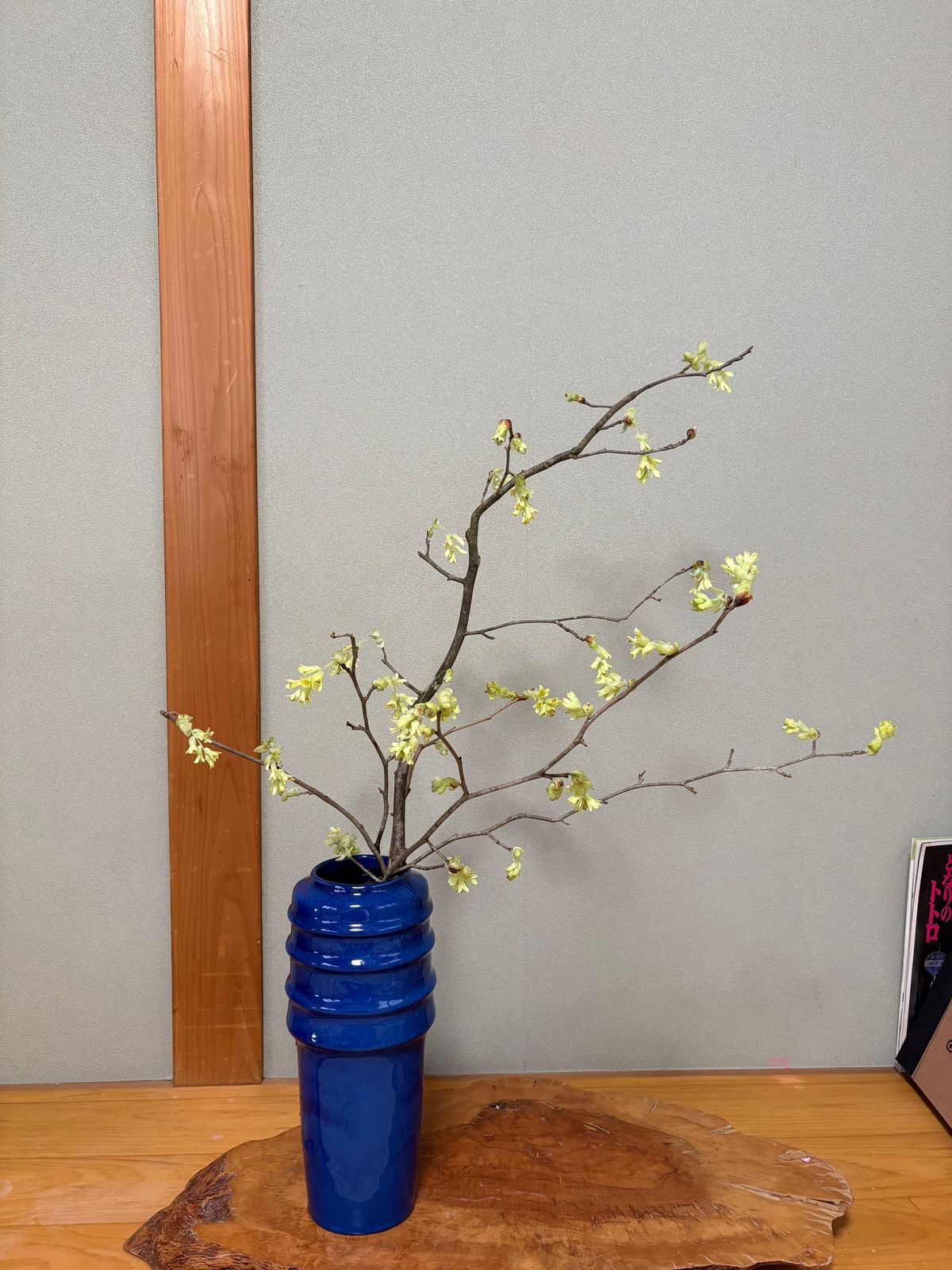
Around this season, flower shops are filled with beautiful branches, cherry blossom, peach, quince, witch hazel, and more.
One of the joys of using branches is watching them bloom little by little each day. When you buy them at the market, they are full of buds. That means the arrangement changes quietly in the vase as the buds begin to open.
However, if we misunderstand the front and back of a branch, we may notice something later: the flowers bloom facing away from us. Instead of opening toward the viewer, they may turn toward the back.
So how do we determine the front and back of a branch? Here are three important observations.
1. Where are the flower buds facing?
Plants grow toward sunlight. Buds naturally orient themselves in the direction of light. This would have been true even before the branch was harvested, meaning that when you buy it, there is already directionality in place.
When you slowly turn a branch in your hands, notice where most of the buds are facing. That direction is often the “front.” When the flowers bloom, they will open toward that side, offering their most beautiful face to the viewer.
2. Which side has darker bark?
Look carefully at the bark. Often, one side appears slightly darker.
The darker side has typically received more sunlight over time. In botanical terms, this side is called the adaxial side. In Japanese, we sometimes refer to it as ha-omote, literally meaning “leaf front.”
Because it consistently faces the sun, this side is considered the natural front of the branch.
3. Which side has more buds?
Sometimes one side of the branch carries more buds than the other.
Why? Because that side received better sunlight exposure, encouraging stronger growth.
When these buds bloom, that side will appear fuller and more vibrant. This is another clue to understanding the branch’s orientation.
Bringing it all together
Try observing these three elements together: bud direction, bark color, and bud distribution. Now you can begin to understand the natural front and back of a branch.
This may feel difficult at first. Every branch grows differently. Nature is not symmetrical, and it does not follow our design preferences. It is a learning process even for the experienced practitioner.
There is no single rule that applies to all ikebana. Our role is not to force the branch into position, but to understand how it has grown and to reveal its most beautiful expression in the vase.
Let’s continue learning to see nature more deeply, together.
Before cutting your branch, rotate it slowly and observe it for one full minute. Do not design yet. Only observe.
Where does it feel open? Where does it feel closed?
With gratitude,
Ryoko