
What is ikebana?
Ikebana is the Japanese art of arranging flowers and other natural materials. Learn its meaning, principles, and why people practice it today.
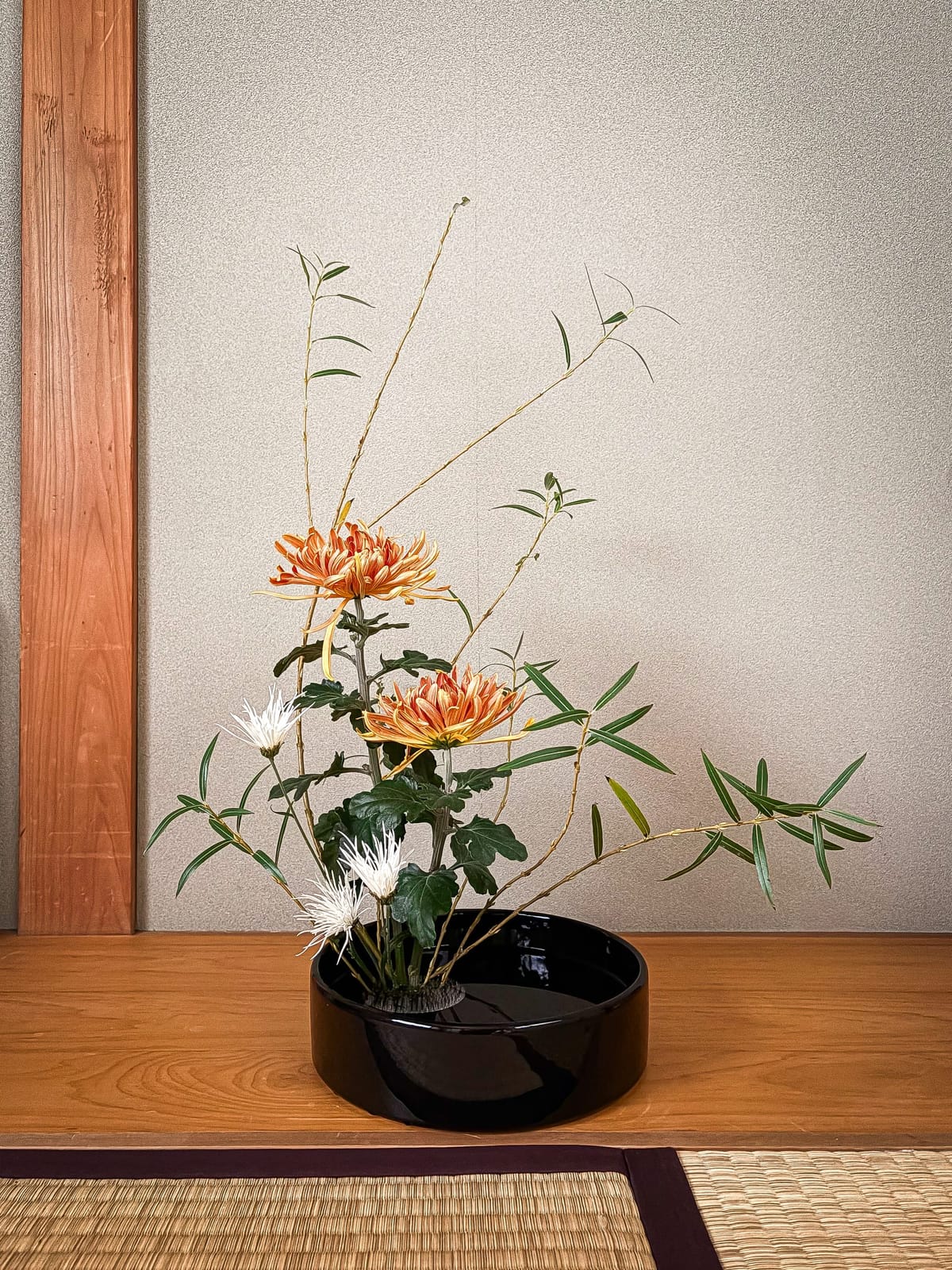
Ikebana is the Japanese art and practice of arranging natural materials such as branches, leaves, and flowers. Rather than focusing on decoration or abundance, ikebana emphasizes lines, space, balance, and seasonal awareness.
The word ikebana (生け花) is commonly translated as “flower arrangement,” but the word itself more closely means giving life to flowers. In practice, ikebana is less about creating a finished object and more about cultivating attention to the materials, to space, and to the moment in which an arrangement is made.
This guide offers a foundational overview of ikebana rather than detailed instruction or school-specific techniques. If you're wondering what ikebana is and why people practice it, you're in the right place.
“Ikebana” is pronounced ee-keh-bah-nah, with even emphasis on each syllable. Note the second syllable is pronounced like “keh” (not “kee”).
How ikebana differs from flower arranging
Ikebana's goals and methods differ from many Western floral traditions. Where Western arrangements often emphasize fullness, symmetry, and visual impact, ikebana values:
- restraint rather than abundance
- structure rather than volume
- intention rather than decoration
An ikebana arrangement may use only a few materials and leave much of the space intentionally empty. But even fuller ikebana arrangements prioritize the relationships between elements over sheer quantity.
Students who are new to ikebana often find the emphasis on simplicity and space challenging at first, as it contrasts with the more-is-more approach common in other floral arts.
Core principles of ikebana
While there are many approaches to ikebana, several core ideas are shared across traditions.
- Lines: Materials are chosen and placed to highlight their natural direction, movement, and character.
- Space: Empty space is an active element in an arrangement, not a gap to be filled. The distance between materials matters as much as the materials themselves.
- Balance: Balance in ikebana is rarely symmetrical. Stability comes from relationships between elements, not mirroring.
- Seasonality: Ikebana responds to the time of year. Materials are chosen to reflect seasonal change rather than resist it.
When and how these principles are applied can vary widely between different schools and styles of ikebana, but they form the foundation of the practice.
Ikebana as a practice
Ikebana developed in Japan over centuries as both a cultural art form and a personal practice. It has roots in Buddhist traditions and was historically practiced by monks, aristocrats, and samurai as a form of meditation and expression.
Ikebana is not something that is completed once and perfected. The same basic structure may be practiced repeatedly over time, using different materials and responding to different seasons. Through repetition, practitioners develop sensitivity, learning to see more clearly rather than learning to produce a single “correct” result.
One arrangement is considered part of an ongoing process rather than a final product. Even a single arrangement can offer multiple opportunities for learning and growth as the materials mature and change.
Materials and imperfection
Ikebana does not require ideal or flawless materials.
Bent branches, irregular stems, unopened buds, and aging leaves are often valued for their character. Imperfection is not treated as a problem to be corrected, but as something that reveals the life of the material.
This appreciation for natural imperfection aligns with broader Japanese aesthetics such as wabi-sabi, which values transience rather than refinement or permanence.
What ikebana looks like in practice
Ikebana arrangements take many forms. Some are created in tall containers with freely standing materials, while others are composed in shallow vessels that emphasize landscape-like compositions.
Despite stylistic differences, ikebana arrangements typically share:
- a clear sense of structure
- visible space between elements
- attention to proportion and direction
Different styles and schools of ikebana explore these ideas in their own ways.
Why people practice ikebana today
People are drawn to ikebana for many reasons. Some practice it as a way to slow down and focus. Others are interested in seasonal living or working directly with natural materials. Increasingly, people from countries outside of Japan look to ikebana practice as a way to gain a deeper appreciation and understanding of Japanese culture.
No matter what the initial reason, ikebana offers a quiet, hands-on, and almost meditative practice that emphasizes observation over performance.
Ikebana does not require artistic background or specialized knowledge to begin. It begins with some basic materials, an open mind, and a guide.
In short
Ikebana is a Japanese practice of arranging natural materials that emphasizes line, space, balance, and seasonality.
Rather than focusing on decoration, ikebana invites careful observation and intentional placement, treating each arrangement as part of an ongoing practice.

